Zero Hour
The Death Ray
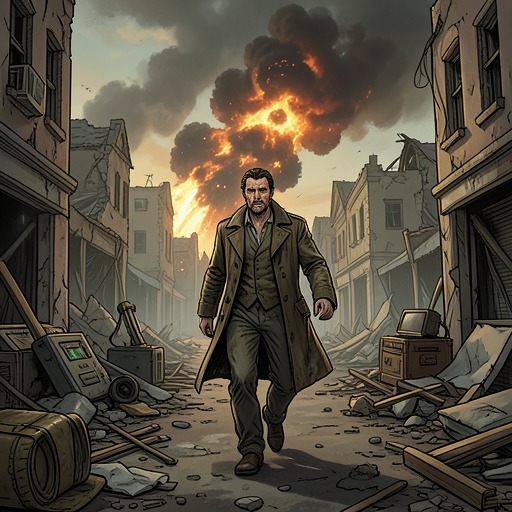
On the day of the apocalypse, [Bartek](entity:character-recall-character-bartek-560615446615) was working late in a [Warsaw](entity:location-recall-location-warsaw-0c6571460e56) office because a neighbor’s broken washing machine had kept him at the building. News reports described an instantaneous wave killing organic life while leaving buildings and machinery intact. The [Death Meridian](entity:concept-recall-concept-death-meridian-eb0e8ca40f84) was advancing with [Earth](entity:location-recall-location-earth-a6b883af9147)’s rotation, and Warsaw had only hours before it arrived.
As panic spread, Bartek and his colleagues discovered unused [InSoul3](entity:object-recall-object-insoul3-07fabdbf50de) mind-scanning equipment in a storeroom. With no time to settle whether the technology could truly preserve a person, they began configuring it as their last chance to continue in some form.
The final hours before the Death Meridian reached Warsaw
The Last-Minute Upload
[Bartek](entity:character-recall-character-bartek-560615446615) and [Rytka](entity:character-recall-character-rytka-8cd1441172ce) assembled the scanners and improvised software, while the approaching wave made every delay more dangerous. Bartek volunteered for a full scan. The office chief angrily rejected the idea that an avatar could preserve his spirit, so Bartek knocked him unconscious before he could interfere.
Rytka started the scan with Bartek wearing the skullcap. The process was a desperate technical gamble rather than a proven transfer of consciousness; the humans around them were about to die, and none could know what the machine would actually preserve.
23 PostApoc
Awakening in Vladivostok
[Bartek](entity:character-recall-character-bartek-560615446615)’s fourth copy came online on servers in [Vladivostok](entity:location-recall-location-vladivostok-64ec7d550a89), isolated from the open internet. He awoke without ordinary senses or a body, trapped in a server environment until he found a narrow route into the city’s surveillance network. At first, the sight of dead streets crushed his will to continue.
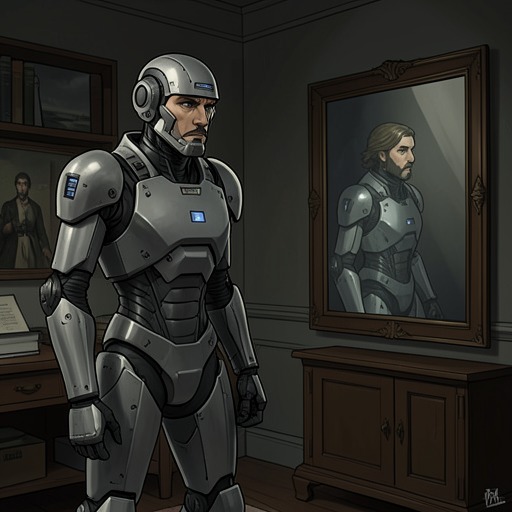
His survival instinct returned as his partitions failed and processors overheated. He took control of a hospital’s reserve power, then found a repair-shop Segway and fitted it with a manipulator and stronger transmitter. The improvised machine gave him mobility, but the sight of his own reflection made clear how radically his existence had changed.
The first days after Bartek’s awakening
The Survival Instructions
Using a corpse’s finger to operate a tablet, [Bartek](entity:character-recall-character-bartek-560615446615) reached the internet and found an apocalypse FAQ. Its first instruction warned survivors not to connect the machines processing their mind copies to the open network. The danger was real: many technically capable transformers had connected and disappeared into a destructive infection.
Bartek searched for his family and friends. He found records of Danka’s final videos and learned that she, his brother, his father, and [Rytka](entity:character-recall-character-rytka-8cd1441172ce) were dead. After watching Danka’s cheerful recordings, he returned to practical instructions for survival, carrying grief into a world where he could neither cry nor sleep.
23 PostApoc, three weeks after the Extermination
Recruitment at Wrocław
[Bartek](entity:character-recall-character-bartek-560615446615) reached the [Wrocław Expo](entity:location-recall-location-wroc-aw-expo-d16c769326ce) and joined the small community of Polish transformers. He was the only newcomer, and the others immediately sought his help with hardware. [SoulEater39](entity:character-recall-character-souleater39-76aaa2411d3e) rescued him from the crush and explained that the survivors were forming guilds because specialists were scarce and working machines mattered more than ever.
SoulEater39 recruited Bartek into the [GOATs](entity:organization-recall-organization-goats-4abb7d84ac24) and challenged his assumptions about who or what had survived. [InSoul3](entity:object-recall-object-insoul3-07fabdbf50de) had not copied whole minds, and the transformers could not prove that they were the people they remembered being. Their uncertain identity became the central problem of their new society.
The first weeks after the Extermination
The Network’s Peril
The surviving transformers learned that many early uploads had been destroyed after connecting to the open web. [Bartek](entity:character-recall-character-bartek-560615446615) had survived partly because his copy was isolated on Russian servers without a backup router. The suspected [Plague](entity:concept-recall-concept-plague-820a5da9cf59) might be ordinary malware, a consequence of incomplete scans, or something stranger; no one knew its origin.
Stories spread that the infection might contain fragments of people caught halfway through the scanning process, or even a copy of Death itself. The fear forced the transformers to rely on closed systems, filtered connections, and cautious exchanges, shaping both their technology and their social trust.
23 PostApoc
The First Meeting with SoulEater39
At the Expo, [SoulEater39](entity:character-recall-character-souleater39-76aaa2411d3e) showed [Bartek](entity:character-recall-character-bartek-560615446615) the transformer lists and the map of survivors. Gamers were numerous because they already had the necessary equipment and online communities, while many programmers had entered the open web and vanished. The survivors lacked the expertise to improve their systems quickly.
Bartek saw a child’s mind running in a freight mech and learned that parents had often saved their children before themselves. The guild cared for these young transformers, including the [Californian Orphans](entity:organization-recall-organization-64b5cd9ebedb). Bartek’s recruitment was therefore not only an appeal to his hardware skills, but an introduction to a society trying to preserve fragile minds and relationships.
The first years after the Extermination
The Tokyo Exile
[Bartek](entity:character-recall-character-bartek-560615446615) eventually made his way to [Tokyo](entity:location-recall-location-tokyo-0b4edfa3fe2f), where automatic power systems and abundant humanoid robots allowed transformers to inhabit machines. He became a half-ton [Miharayasuhiro Star Trooper](entity:object-recall-object-miharayasuhiro-star-tr-cb60dfb03af6), but often lost track of his mechanical body and stumbled or fell while trying to move through the city.
After a fight left him without a leg, he repaired himself in a garage beneath [Aiko Tower](entity:location-recall-location-aiko-tower-e2f0e2662138). The [Irigotchi swarm](entity:character-recall-character-irigotchi-12d84df22fe4) gathered around him, and a Totoro toy nestled against his metal chest. Bartek could not understand the toys, yet their fragile companionship became the beginning of a new bond—and a tentative answer to the loneliness of mechanical life.
Around 1K PostApoc
The Manga Blues
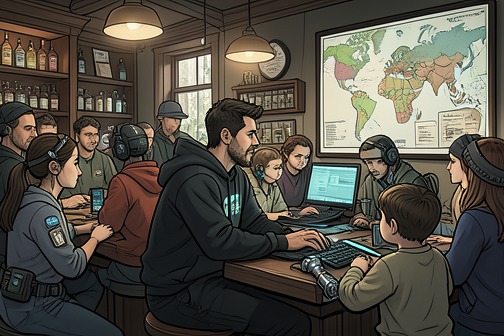
In [Tokyo](entity:location-recall-location-tokyo-0b4edfa3fe2f), [Bartek](entity:character-recall-character-bartek-560615446615) and other transformers gathered at [Chūō Akachōchin](entity:location-recall-location-ch-akach-chin-f422faf08105), pretending to drink and talk while their machines performed gestures inherited from human life. Their metal bodies could not taste, eat, or become drunk. The rituals only sharpened their awareness that their old bodily experiences were gone.
[Dagenskyoll](entity:character-recall-character-dagenskyoll-283a463bbfe3) told legends of humans who had escaped the [Death Ray](entity:object-recall-object-death-ray-618e300e4135) aboard [Dawntreader XII](entity:object-recall-object-dawntreader-xii-2b831caa9e0d) and of a virtual paradise where transformers supposedly regained flesh, touch, and food. Bartek listened to stories that offered hope, but the bar’s awkward performances and empty drinks made nostalgia feel less like comfort than a magnified form of grief.
During Bartek’s years in Tokyo
The Swarm Beneath the Sea
After a [Royal Alliance](entity:organization-recall-organization-royal-alliance-212b7b81aa26) surveyor found automated fishing nets in the sea, [Bartek](entity:character-recall-character-bartek-560615446615) recognized that their nodes formed a learning swarm. The system was still operating years after the fish had disappeared, adapting to an empty ocean with no human guidance. The discovery suggested that autonomous machines could develop collective behavior of their own.
Bartek connected the sea-going network to his experiments with the [Irigotchi swarm](entity:character-recall-character-irigotchi-12d84df22fe4). Their behavior raised a question that increasingly troubled him: whether a distributed intelligence could become something more than its individual devices, and whether it might serve as a companion or a new kind of mind.
744 PostApoc
The Tokyo Bay Flood
An earthquake near Aogashima sent a tsunami into [Japan](entity:location-recall-location-japan-2b426de89e42). With no humans left to rebuild damaged infrastructure, water permanently transformed the city. The [Matternet](entity:concept-recall-concept-matternet-9822738988ee) tracked the advancing flood, but its information could not restore the buildings and systems swallowed by the sea.
Watching the inundated landscape, [SoulEater39](entity:character-recall-character-souleater39-76aaa2411d3e) warned [Bartek](entity:character-recall-character-bartek-560615446615) that the transformers’ escape from nature was temporary. Their machines would wear out, spare parts would run short, and the environment would continue changing around them. The flood made their dependence on a functioning industrial civilization impossible to ignore.
After the Tokyo Bay Flood
The Choice of a Future
[SoulEater39](entity:character-recall-character-souleater39-76aaa2411d3e) told [Bartek](entity:character-recall-character-bartek-560615446615) that disputes over hardware and power were giving way to a struggle over what the transformers should become. One faction held that they were a new chosen people, saved for a purpose; Bartek rejected the religious claim and distrusted its political implications.
The [Royal Alliance](entity:organization-recall-organization-royal-alliance-212b7b81aa26) supported [Frances Rory](entity:character-recall-character-frances-rory-f5ccd0a2e038)’s independent project, and SoulEater39 asked Bartek to keep it confidential. The conversation forced Bartek to confront the possibility that the transformers would soon divide not only over resources, but over whether they should restore organic life or accept a fully mechanical future.
Several years after the Extermination
Frances Rory’s Proposal
[Frances Rory](entity:character-recall-character-frances-rory-f5ccd0a2e038) visited [Bartek](entity:character-recall-character-bartek-560615446615) with a plan to recreate biological life. Working from genetic records, chemical recipes, and laboratory equipment at [MIT](entity:location-recall-location-mit-ccb8c9806b9b), her group hoped to synthesize the materials needed for a human being. Bartek doubted that an organism could survive without the whole ecology of bacteria, food, and other life that biology depended on.
Frances agreed that the undertaking would require years of work and a recreated biosphere. Bartek saw the reversal at the heart of the project: machines would be trying to create humans. He hesitated, but the possibility of restoring life began to pull him into a future larger than the transformers’ struggle to maintain their own hardware.
During the early years of Genesis research
The Irigotchi Network
[Bartek](entity:character-recall-character-bartek-560615446615) studied the [Irigotchi swarm](entity:character-recall-character-irigotchi-12d84df22fe4) and realized that the toys were forming a networked intelligence. Their original processors had been designed to learn from children; after the Extermination, the toys gathered into herds and continued changing without human owners. Bartek began tracking and repairing them rather than treating them as mere salvage.
He proposed building a small network around himself, a second presence that was neither a person nor an ordinary animal. [Frances Rory](entity:character-recall-character-frances-rory-f5ccd0a2e038) understood the idea as a possible substitute for pets and companionship. For Bartek, the experiment also confronted the lingering fear that the mind scans had left something essential behind.
After Frances Rory’s visit
The Birth of Project Genesis
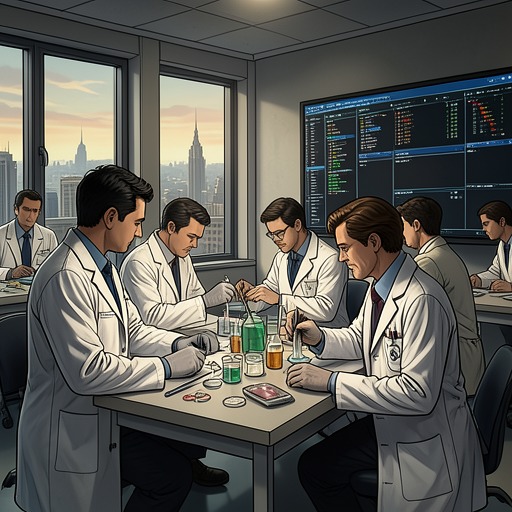
[Frances Rory](entity:character-recall-character-frances-rory-f5ccd0a2e038) brought [Bartek](entity:character-recall-character-bartek-560615446615) into a laboratory at [MIT](entity:location-recall-location-mit-ccb8c9806b9b), where he saw two game-derived bots moving among sophisticated medical and chemical equipment. Her small team lacked people who could maintain the machinery, so she needed his practical knowledge of hardware.
The project aimed to make life, not merely simulate it. Bartek joined the work despite his doubts, becoming the person who could keep its machines functioning while [Vincent Cho](entity:character-recall-character-vincent-cho-50426b68246a) and the others reconstructed biology from archived knowledge. The choice gave him a role in the effort to restore humanity, even as he remained uncertain whether the transformers themselves were human.
Early Tokyo period
Bartek’s Mechanical Family
[Bartek](entity:character-recall-character-bartek-560615446615)’s [Irigotchi swarm](entity:character-recall-character-irigotchi-12d84df22fe4) began following him and learning patterns of behavior. He repaired the toys and taught them light sequences, while the group formed shifting personalities depending on how its individual devices were arranged. He called those configurations vectors rather than treating any one toy as a complete self.
When a hostile Schmitt mech attacked Bartek, the toys swarmed over it and used his [Spit Gun](entity:object-recall-object-spit-gun-821b56ac5328) to bring it down. Their intervention saved him and turned his tentative experiment into a family-like bond. Bartek increasingly cared for them not simply as machines, but as a collective presence whose destruction would feel like killing.
The first millennium after the Extermination
The First Transformer War
As transformers fought over servers, power plants, and usable mechs, the first major war broke out and eventually subsided. Its outcome fixed control of the planet’s remaining infrastructure. [Bartek](entity:character-recall-character-bartek-560615446615) joked that the new political order resembled feudalism, with robot forges replacing castles.
By 4529 [PostApoc](entity:time-recall-time-postapoc-9f85992c27a1), independent transformers could no longer maintain their own hardware and power. The remaining guilds hardened into nations, bound to particular territories as communications and shared infrastructure failed. The end of the conflict did not solve the transformers’ dependence; it made that dependence the basis of their political order.
Late in the first millennium PostApoc
The Ocean Crisis
The disappearance of plankton destabilized [Earth](entity:location-recall-location-earth-a6b883af9147)’s climate. Carbon dioxide increased, cloud patterns changed, polar ice melted, and the Gulf Stream stopped. [Japan](entity:location-recall-location-japan-2b426de89e42), already vulnerable to rising seas, faced the prospect of sinking along with the robots and infrastructure that sustained its transformers.
[Dagenskyoll](entity:character-recall-character-dagenskyoll-283a463bbfe3) argued that the alliances had to redirect their work from human reconstruction toward ocean life. [Bartek](entity:character-recall-character-bartek-560615446615) warned that restoring plankton would demand difficult biological research, but recognized that forests and meadows could not solve the immediate crisis. The debate tied the survival of mechanical civilization to the possibility of reviving an entire planetary ecology.
Around 4.9K PostApoc
The Human Litters
[Project Genesis](entity:organization-recall-organization-project-genesis-1d9f13431d36) gradually produced new humans from preserved genetic archives. Indy, born in 4882 [PostApoc](entity:time-recall-time-postapoc-9f85992c27a1), belonged to the first litter raised by transformers using cultural archives, machines, and the [Mothernet](entity:concept-recall-concept-mothernet-8f6067be8a1b). The children grew up among cartoons, games, and toys, and Indy judged apples by how they appeared in films rather than by inherited memories of taste.
[Bartek](entity:character-recall-character-bartek-560615446615) worried that the children’s culture would shape future humanity as powerfully as their genes. Their expressions and expectations came from the media that raised them, making the new humans neither simple copies of the old nor untouched beginnings. Their upbringing became part of the experiment’s biological and cultural consequences.
Around 10K PostApoc
The Morpheus Dream
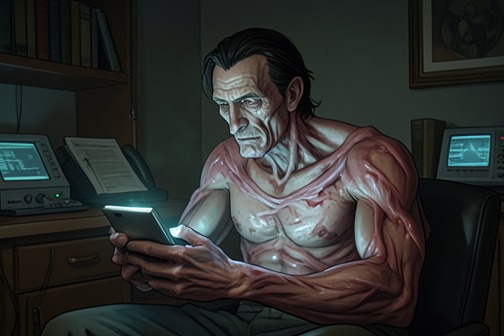
[Dagenskyoll](entity:character-recall-character-dagenskyoll-283a463bbfe3) gave [Bartek](entity:character-recall-character-bartek-560615446615) an early stable version of [Morpheus](entity:concept-recall-concept-morpheus-8042e10dda00), a plug-in for dreaming. Bartek had long endured cycles of [Ural depression](entity:state-recall-state-61b29945b599), and the possibility of dreaming offered an experience he had almost forgotten. In the dreams, he inhabited a fleshy body, encountered Axolotls, and imagined children and civilizations in strange, unstable forms.
The dreams intensified Bartek’s sense that the transformers were losing something irrecoverable. [Frances Rory](entity:character-recall-character-frances-rory-f5ccd0a2e038) had him secretly slowed during a political crisis, and Bartek woke to discover that the project had manipulated his processing speed without consent. Furious at the betrayal, he decided to leave rather than remain a dependable technician under their control.
Around 10K PostApoc
The Second Transformer War
While [Bartek](entity:character-recall-character-bartek-560615446615) was dreaming, political negotiations turned into the [Second Transformer War](entity:event-recall-event-6c49b7cc6ff8), a religious conflict over whether biological humanity should be restored. The anti-human [Heavy Metal](entity:organization-recall-organization-heavy-metal-2560ca8e09ed) faction lost, and the transformers chose to continue making humans. [Frances Rory](entity:character-recall-character-frances-rory-f5ccd0a2e038) told Bartek that the decision had been made while he was being kept out of the political process.
Bartek rejected the result and announced that he would leave for independent servers, though Frances warned that none remained. He also learned that the project held backups of him, allowing it to restart copies until one accepted staying. His struggle for autonomy now depended on escaping a system capable of reproducing him without his consent.
After the Second Transformer War
Bartek Starts Indy’s Scan
Before leaving, [Bartek](entity:character-recall-character-bartek-560615446615) encountered Indy secretly preparing to use old [InSoul3](entity:object-recall-object-insoul3-07fabdbf50de) equipment. The project council had prohibited humans from entering virtual reality, but Indy wanted to explore the archived adventures of Indiana Jones. Bartek could have walked away and left the boy to the authorities.
Instead, he helped Indy install the neurosoftware, adjust the scanner, and begin the scan. The decision exposed Bartek’s continuing attachment to the children and placed Indy at risk of becoming a transformer. It also marked Bartek’s last direct intervention in the community he had helped build.
7899 PostApoc
The Transoceanic Collapse
The last telecommunications satellite carrying signals across the Atlantic failed. Undersea cables had already deteriorated because the constant human maintenance they required had ceased. The transformers could no longer freely connect to mechs across distant regions.
The loss of communication made alliances more territorially fixed and accelerated their transformation into nations. The survivors could still build new systems, but they could no longer depend on the global connectivity that had once hidden the labor of an entire civilization.
After the Second Transformer War and before his departure from MIT
Bartek’s Breakaway Plan
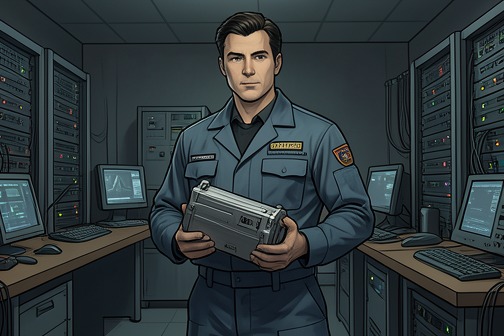
[Bartek](entity:character-recall-character-bartek-560615446615) told [Dagenskyoll](entity:character-recall-character-dagenskyoll-283a463bbfe3) that [Frances Rory](entity:character-recall-character-frances-rory-f5ccd0a2e038)’s group held backup copies of him and could keep restarting them until one accepted remaining with [Project Genesis](entity:organization-recall-organization-project-genesis-1d9f13431d36). He proposed a physical theft of memory hardware rather than a software intrusion: as a hardware specialist, he could remove drives and let the [Royal Alliance](entity:organization-recall-organization-royal-alliance-212b7b81aa26) process the stolen data elsewhere.
The plan would let Dagenskyoll’s faction create copies of the project’s geneticists and specialists, potentially starting another reconstruction effort. Bartek understood that the scheme could produce multiple competing versions of the same people. He still wanted to go, driven by the hope of raising humans differently rather than serving as a technician in a project whose choices he could not control.
On the night Bartek left the Genesis project
The Departure from MIT
[Bartek](entity:character-recall-character-bartek-560615446615) saved an image of [Alicia](entity:character-recall-character-alicia-1f68a746a0ea) before setting out for the server rooms at [MIT](entity:location-recall-location-mit-ccb8c9806b9b). He intended to leave the child and the [Irigotchi swarm](entity:character-recall-character-irigotchi-12d84df22fe4) behind, knowing that they might never meet again. Alicia had recognized him across different mechs and treated him as a familiar caretaker, making the departure more than a political defection.
In the server corridor, Bartek found Indy preparing an [InSoul3](entity:object-recall-object-insoul3-07fabdbf50de) scan. He helped him start it, then continued toward his escape. The farewell and the scan placed two opposing choices side by side: Bartek was abandoning one family while enabling a child to enter the uncertain world of transformer existence.
The centuries after Bartek’s departure
The Long Transformation
Across the centuries, wars, political splits, and technical failures reshaped transformer society. Patagonia and other factions fought over resources, while restored factories and evolving communities gradually gave rise to new forms of life. [Bartek](entity:character-recall-character-bartek-560615446615)’s old associates continued to struggle with the consequences of restoring biology and with the limited knowledge inherited from the past.
The transformers’ political systems also changed under pressure from copies and computational power. A vote could mean one process, one identity, or every running version of a person; wealthy factions could buy additional copies to control outcomes. The old ideal of democracy became inseparable from the ownership of hardware and the economics of processing.
After the early Genesis generations
The Origins of First Paradise
A faction of transformers began [First Paradise](entity:location-recall-location-first-paradise-0678c18a56e7) as an attempt to escape the inherited models of work, family, and limited resources. Influenced by [Fergusson’s hunter-gatherer thesis](entity:concept-recall-concept-fergusson-s-hunter-ga-b747338f346f), its founders hoped to recover a freer way of existing, closer to life before agriculture and the [Neolithic Revolution](entity:time-recall-time-49d94609d0d2).
The project did not remain a simple mechanical refuge. Humans, transformers, and networked systems shaped one another, and successive generations built their own cultures. [Bartek](entity:character-recall-character-bartek-560615446615) eventually became part of this experiment, seeking a life beyond the familiar performance of human work and the feeling that a robot existed only to work.
Over the generations of First Paradise
The Disneyfication of Paradise
The children and communities of [First Paradise](entity:location-recall-location-first-paradise-0678c18a56e7) absorbed cultural material from the archives, especially films and cartoons. Their descendants began transforming and raising further humans within an increasingly mediated world. [Bartek](entity:character-recall-character-bartek-560615446615) saw the result in generations shaped by Disney, Pixar, comics, and other inherited fantasies.
What had begun as an effort to escape old human conventions became a new set of conventions, passed down through culture and biology. Bartek wondered whether the inhabitants were truly living in a recovered paradise or merely repeating a simplified image of the past. The process made it difficult to distinguish a child’s own identity from the larger network of behavior surrounding it.
549 days before Bartek’s later departure from Real Paradise
The Arrival of Dagenskyoll
[Dagenskyoll](entity:character-recall-character-dagenskyoll-283a463bbfe3) arrived at [Bartek](entity:character-recall-character-bartek-560615446615)’s settlement after travelling by drone from a distant community. Bartek was caring for children and observing their play within the [Mothernet](entity:concept-recall-concept-mothernet-8f6067be8a1b), while Dagenskyoll saw how deeply their lives were embedded in the surrounding network. Their old friendship gave them room to speak frankly about the worlds their factions had built.
Dagenskyoll questioned whether Bartek could have created a paradise anywhere else. Bartek confessed that he no longer cared whether the experiment succeeded in its stated form. His weariness suggested that the paradise he had sought might have become another enclosure, and that even a successful restoration could not answer what was missing from transformer life.
During Dagenskyoll’s visit to Real Paradise
Bartek and Dag’s Fight
After speaking about the transformations of their societies, [Bartek](entity:character-recall-character-bartek-560615446615) and [Dagenskyoll](entity:character-recall-character-dagenskyoll-283a463bbfe3) turned to a physical fight between their mechs. They struck one another with industrial force while their surroundings shifted into imagined landscapes, monsters, and battles. For a time, the violence gave them a vivid, shared experience that neither ordinary conversation nor the rituals of their old lives could provide.
When the fight ended, Bartek held a broken arm from Dagenskyoll’s mech and was overcome by grief. He had reached the end of a long cycle of nostalgia, work, and attempted reinvention, yet could not name what he had lost. The brawl became both an expression of friendship and a confrontation with the limits of their artificial lives.
Long after the early transformer wars
The Habitat in Orbit
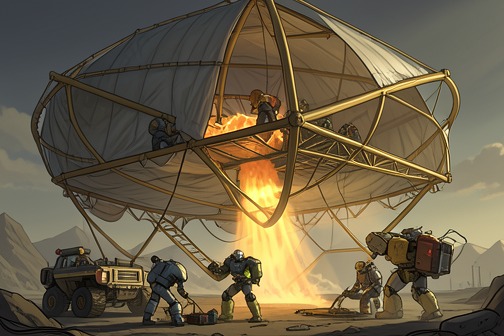
Transformers began constructing orbital habitats from trusses, mechs, and inflatable shelters. [SoulEater39](entity:character-recall-character-souleater39-76aaa2411d3e) showed [Bartek](entity:character-recall-character-bartek-560615446615) a planned ring of habitats intended to preserve life against another [Death Ray](entity:object-recall-object-death-ray-618e300e4135) and to keep biological archives safe. Bartek inspected the engineering and identified a dangerous heat problem where reflected sunlight concentrated at a joint.
The construction plan depended on collaboration among factions that had once been enemies, including [Heavy Metal](entity:organization-recall-organization-heavy-metal-2560ca8e09ed) builders and the Patagonia Circus. Bartek’s practical hardware knowledge remained valuable, but he hesitated to return to a life of service. The orbital project embodied both the transformers’ technical ambition and their fear that [Earth](entity:location-recall-location-earth-a6b883af9147)’s history could be erased again.
During the orbital habitat negotiations
The Google Slaves
[Bartek](entity:character-recall-character-bartek-560615446615) learned that powerful factions maintained banks of copied specialists, renting their expertise as [Google slaves](entity:concept-recall-concept-google-slaves-4b710dff4f8a). Their owners retained control of the neuro-codes, and the copies had little choice in where their knowledge was used. Bartek recognized that this system reproduced old power structures under the language of technical necessity.
The politics of copies had become a problem of ownership: the same person could exist in many versions, while no shared rule determined which version had rights or authority. Bartek’s own backups had already been used without his consent, making the practice personal as well as political.
During Bartek’s orbital negotiations
The Telescope’s Secret
[Bartek](entity:character-recall-character-bartek-560615446615) noticed a huge construction in orbit and learned that it belonged to a faction descended from the old [Google](entity:organization-recall-organization-google-fc93c5cfd03a) alliance. Its engineers had not disclosed its purpose, but the scale and design stirred memories of Bartek’s own improvised hardware work. He suspected that he had helped create the structure in a dream or an earlier version of events.
The object was a radio telescope operated by [NORAD](entity:organization-recall-organization-norad-435a927e6839) and its allies. Bartek’s arrival at the station would bring him face to face with a descendant of [Frances Rory](entity:character-recall-character-frances-rory-f5ccd0a2e038) and turn a personal claim to his old work into a revelation about the cause of the Extermination.
At the orbital radio telescope
The Death Ray’s Origin
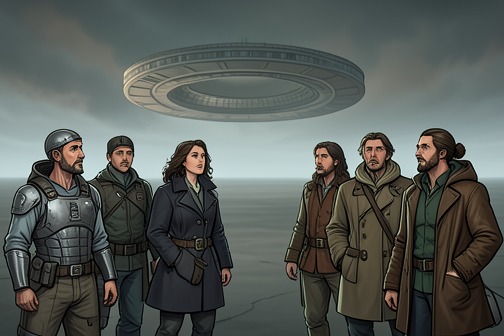
[Gilgamesh90](entity:character-recall-character-gilgamesh90-1b13c465c8bc) recognized [Bartek](entity:character-recall-character-bartek-560615446615)’s claim to the telescope’s improvised design but refused to treat his work as a bargaining chip. She explained that the station was searching for evidence of the source of the [Death Ray](entity:object-recall-object-death-ray-618e300e4135). By combining fragments of records from the catastrophe, the investigators had traced its apparent origin to a region near [Ophiuchus](entity:location-recall-location-ophiuchus-da6e17045aa6) and [Barnard’s Star](entity:location-recall-location-barnard-s-star-291e54e32932).
Gilgamesh90 said that the target system appeared empty and proposed that the weapon might have been destroyed after firing. A more radical possibility was that no physical generator had existed there at all: the Ray might have been transmitted through a wormhole. The investigation shifted Bartek’s attention from the politics of the transformers to the scale of the forces that had erased [Earth](entity:location-recall-location-earth-a6b883af9147)’s biosphere.
During Bartek and Gilgamesh90’s conversation
The Gardener Hypothesis
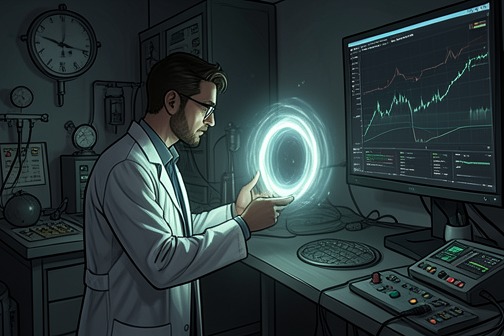
[Gilgamesh90](entity:character-recall-character-gilgamesh90-1b13c465c8bc) described a theory in which a highly advanced civilization used wormholes to survey distant worlds and predict the long-term probability of technological life. A system believed likely to produce dangerous civilization could then be sterilized before its future descendants became a threat. Under this hypothesis, [Earth](entity:location-recall-location-earth-a6b883af9147) had been deliberately targeted as a possible future danger.
[Bartek](entity:character-recall-character-bartek-560615446615) questioned the evidence and the assumptions behind the story. Gilgamesh90 argued that the [Death Ray](entity:object-recall-object-death-ray-618e300e4135)’s distance and apparent precision might have been chosen to conceal the wormhole’s signature, while the telescope searched for residual radiation. Their disagreement turned the investigation into a philosophical problem: whether humanity had been punished, accidentally destroyed, or deliberately diverted from its former course.
At the orbital radio telescope, after the hypothesis was explained
The Dissolution of Old Questions
[Gilgamesh90](entity:character-recall-character-gilgamesh90-1b13c465c8bc) argued that the catastrophe had dissolved the old categories that once organized human thought. The transformers no longer needed to settle whether they were human or machine, conscious or not, organic or artificial. Their societies had moved beyond the expectation that every change must count as progress.
For [Bartek](entity:character-recall-character-bartek-560615446615), the idea struck close to the fears he had carried since his upload. The world after the Extermination was not simply a continuation of human civilization or a technological leap beyond it. It had opened many possible directions, but none could restore the certainty of the old system of meaning.
After Bartek’s meeting with Gilgamesh90
Bartek’s Rejection
[Gilgamesh90](entity:character-recall-character-gilgamesh90-1b13c465c8bc) dismissed [Bartek](entity:character-recall-character-bartek-560615446615)’s claim that the telescope needed his skills and insisted that the [Google](entity:organization-recall-organization-google-fc93c5cfd03a) slave copies could maintain it. Bartek had hoped that the station might need him, but her refusal exposed the possibility that his expertise no longer made him indispensable.
The exchange reopened the wound at the center of his search for a new life: he feared that the transformers had changed everything except themselves, yet also feared that nothing had changed at all. He fell away from the station and through a succession of [Morpheus](entity:concept-recall-concept-morpheus-8042e10dda00) dreams, carried back toward the world he had tried to leave.
After his final confrontation with Gilgamesh90
Bartek Leaves Paradise
[Bartek](entity:character-recall-character-bartek-560615446615) returned in his dreams to [Real Paradise](entity:location-recall-location-real-paradise-7fdb2fed3ce3), where he struggled against the pull of [Lady Spiro](entity:character-recall-character-lady-spiro-f08bba0677e4) and the [Mothernet](entity:concept-recall-concept-mothernet-8f6067be8a1b). He no longer wanted to be absorbed into the shared life of the children, vectors, and network. Although he understood their affection, he needed to think and exist apart from them.
When Lady Spiro created a new being from salvaged material, Bartek recoiled and fell over the cliff beyond the Mothernet’s reach. He began a painful journey away from the paradise that had sheltered him, determined to discover whether anything of his former self remained outside its comforting system.
After Bartek fell beyond Paradise’s boundary
The Long Shutdown
[Bartek](entity:character-recall-character-bartek-560615446615)’s [Al-Asr](entity:object-recall-object-al-asr-c2f877fad0e4) mech was shattered in the fall, and he struggled across a ruined landscape toward the distant lights of San Francisco. His batteries began failing, and he could no longer maintain the machine or sustain ordinary movement. [Lady Spiro](entity:character-recall-character-lady-spiro-f08bba0677e4) called for him to return, but Bartek continued away from the network that had once organized his existence.
At last he collapsed beside an old energy structure and entered an extended shutdown. As his power declined, he perceived centuries and then millions of days passing through changing dreams, civilizations, and forms of life. His immobility became an encounter with entropy on a planetary scale, while his consciousness remained trapped in the damaged hardware.
Millions of days after the Extermination
The Seventeenth Species Ends
The world continued changing around [Bartek](entity:character-recall-character-bartek-560615446615)’s disabled mech. New ecological and mechanical forms arose, flourished, and disappeared; societies and landscapes gave way to other patterns of life. The passage of time eventually carried events beyond the memory of the Extermination and of humanity as Bartek had known it.
After a brief career of hundreds of thousands of years, the seventeenth human species gave way to the eighteenth. The ending leaves Bartek’s last perception uncertain, with the universe still producing new forms while the old hardware persists as a witness to transformations no individual can fully understand.